CULTURE & SPIRITUALITY
BUDDHISM IN BHUTAN
Vajrayana Buddhism is the official state religion of Bhutan, with the majority of the population practicing it. Its roots are in Tibetan Buddhism, introduced by the 8th-century sage Guru Rimpoche (Padmasambhava). Buddhism is deeply integrated into Bhutanese culture and governance, shaping national values, politics, and the concept of Gross National Happiness.
OFFICIAL AND STATE RELIGION:
The constitution recognizes Buddhism, and the government financially supports monasteries, monks, and nuns.
VAJRAYANA BUDDHISM:
The specific school of Buddhism practiced is Vajrayana, which is a branch of Mahayana Buddhism, as opposed to the Theravada Buddhism found in Southeast Asia.
HISTORICAL INFLUENCE:
The religion was brought to Bhutan by Guru Rimpoche, who is revered as the "second Buddha". He helped establish monasteries and is credited with subduing local spirits through Buddhist practices.
CULTURAL INTEGRATION:
Buddhist values are woven into the fabric of society, influencing daily life, education, and the national philosophy of Gross National Happiness (GNH), which prioritizes spiritual well-being over material gain.
GOVERNANCE:
Leaders are expected to rule with moral integrity, and the justice system emphasizes rehabilitation and harmony.
ECONOMIC AND POLITICAL:
The government has supported religious institutions and guaranteed representation for Buddhists in public policy-making bodies.
COMMUNITY PRACTICES:
Important rituals include those surrounding death, where ceremonies are performed to help the deceased transition to the next life. Prayer wheels are also a common sight, used to spread prayers.
MONASTIC LIFE:
The Drukpa Kagyu denomination of Tibetan Buddhism is prominent, but other schools like Nyingmapa also exist.
MONASTERIES & SACRED SITES
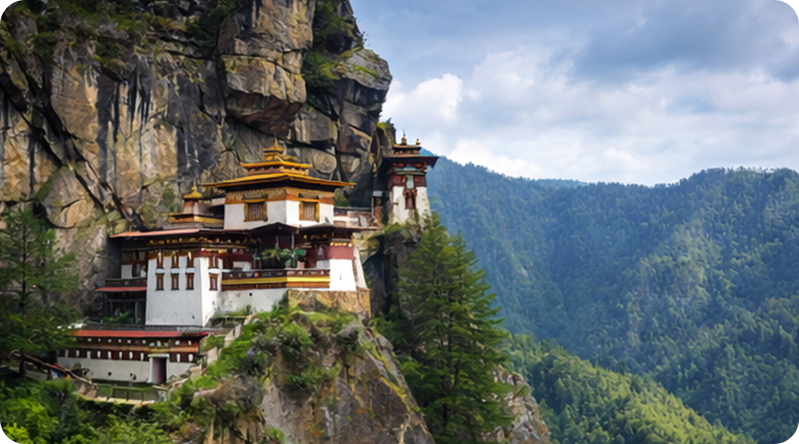
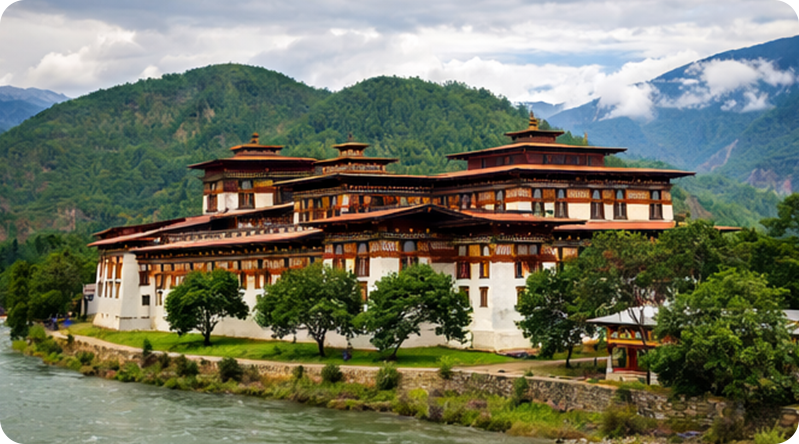
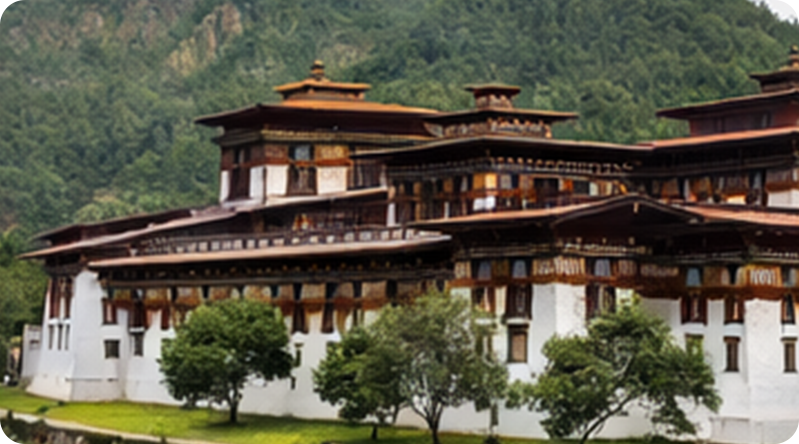
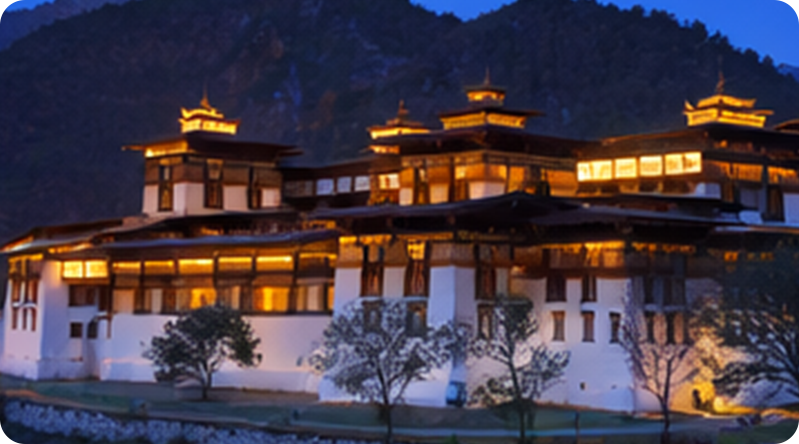
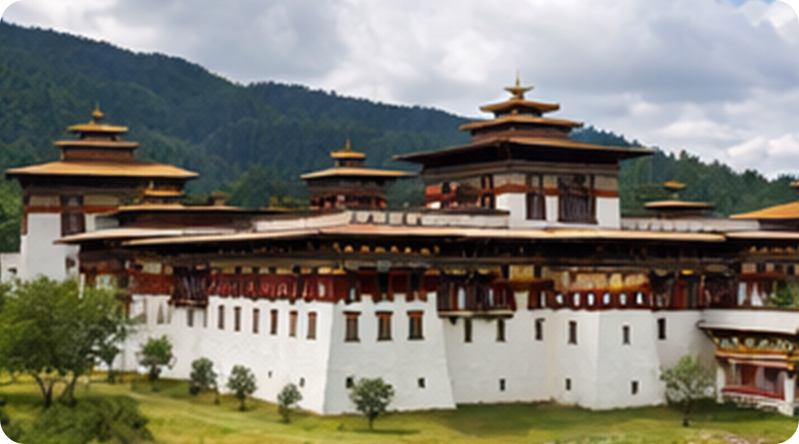
Bhutan’s monasteries and sacred sites include iconic locations like Paro Taktsang (Tiger’s Nest) and the Punakha Dzong, which are known for their stunning architecture and spiritual significance. Other important sites include the Rinpung Dzong, Tashichho Dzong, and Gangtey Monastery, which serve as important religious, cultural, and administrative centers. These locations are often described as architectural marvels that offer a deep insight into the country’s rich Buddhist traditions.
NATIONAL FESTIVALS
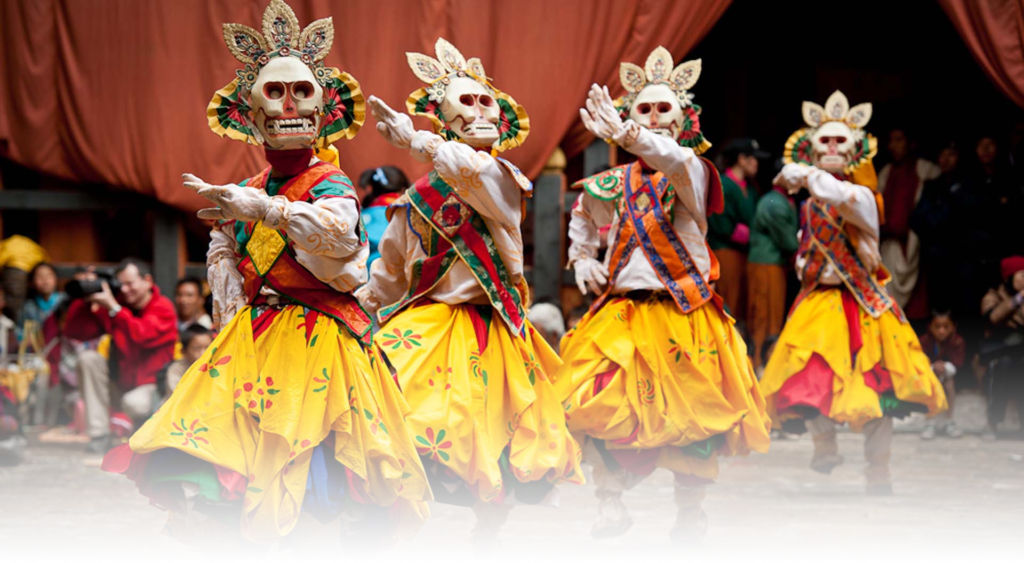
A land of happiness and prosperity, Bhutan is a country that is replete with pristine beauty and captivating heritage. Be it its monasteries, the Himalayan range, the deep valleys and meadows or popular fairs and festivals in Bhutan, the kingdom has everything to offer to its travellers. Each and every aspect of the nation is equally enthralling. The high-spirited religious festivals have become a crowd puller in the recent times. That is because the Bhutanese people have done everything in their power to keep their culture and traditions intact ever since it came into existence. Popularly known as Tshechus, one cannot miss out on witnessing the absolutely spectacular celebrations that take place in Bhutan.
- PUNAKHA DRUBCHEN
- PARO TSHECHU
- THIMPHU TSHECHU
- GOMPHU KORA FESTIVAL
- JAMBAY LHAKHANG DRUP
- PUNAKHA DRUBCHEN
- PARO TSHECHU
- THIMPHU TSHECHU
- GOMPHU KORA FESTIVAL
- JAMBAY LHAKHANG DRUP
TRADITIONAL ARTS & CRAFTS
In Bhutan, the traditional arts are known as zorig chusum (zo = the ability to make; rig = science or craft; chusum = thirteen). These practices have been gradually developed through the centuries, often passed down through families with long-standing relations to a particular craft. These traditional crafts represent hundreds of years of knowledge and ability that has been passed down through generations.
- Dezo - Paper Making: Handmade paper made mainly from the Daphne plant and gum from a creeper root.
- Dozo - Stonework: Stone arts used in the construction of stone pools and the outer walls of dzongs, gompas, stupas and some other buildings.
- Garzo - Blacksmithing: The manufacture of iron goods, such as farm tools, knives, swords, and utensils.
- Jinzo - Clay arts: The making of religious statues and ritual objects, pottery and the construction of buildings using mortar, plaster, and rammed earth.
- Lhazo - Painting: From the images on thangkas, walls paintings, and statues to the decorations on furniture and window-frames.
- Lugzo Bronze casting: Production of bronze roof-crests, statues, bells, and ritual instruments, in addition to jewelry and household items using sand casting and lost-wax casting. Larger statues are made by repoussé.
- Lugzo Bronze casting: Production of bronze roof-crests, statues, bells, and ritual instruments, in addition to jewelry and household items using sand casting and lost-wax casting. Larger statues are made by repoussé.
- Shagzo - Woodturning: Making a variety of bowls, plates, cups, and other containers.
- Shingzo - Woodworking: Employed in the construction of dzongs and gompas
- Thagzo - Weaving: The production of some of the most intricately woven fabrics produced in Asia.
- Trözo Silver- and gold-smithing: Working in gold, silver, and copper to make jewelry, ritual objects, and utilitarian household items.
- Tshazo Cane and bamboo work: The production of such varied items as bows and arrows, baskets, drinks containers, utensils, musical instruments, fences, and mats.
- Tshemazo - Needlework: Working with needle and thread to make clothes, boots, or the most intricate of appliqué thangkas.
MUSIC, DANCE & LITERATURE
Music, dance, and literature form the vibrant heartbeat of cultural expression, reflecting history, spirituality, and collective identity. Traditional melodies, rhythmic performances, and poetic storytelling preserve ancestral wisdom while inspiring modern creativity. Festivals and ceremonial gatherings showcase artistic talent, where performers embody heritage through graceful movements and symbolic lyrics. Literature further strengthens cultural continuity by documenting legends, values, and philosophical teachings passed across generations. Together, these artistic traditions nurture unity, celebrate diversity, and ensure that cultural narratives remain alive within communities and beyond national boundaries.
Through artistic expression, society strengthens identity and fosters mutual understanding. Music, dance, and literature continue to inspire creativity, preserve heritage, and connect generations, ensuring traditions evolve gracefully while remaining rooted in cultural pride and timeless values.
NATIONAL SYMBOLS
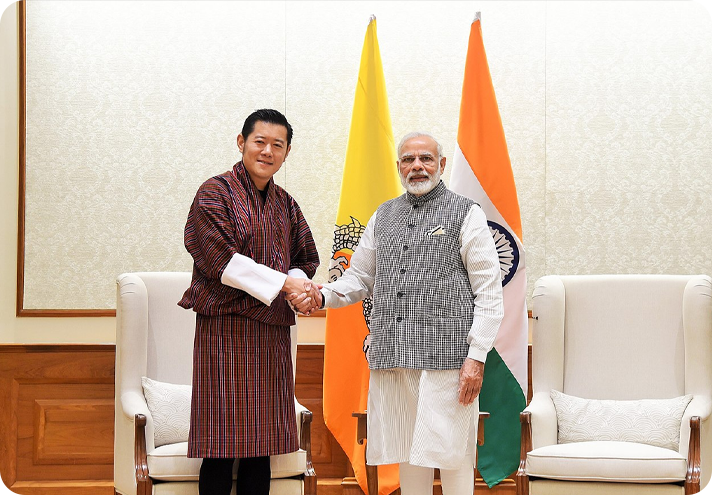
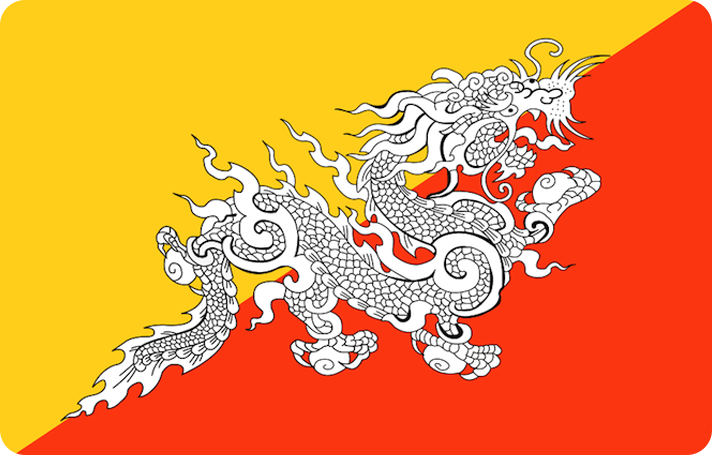
Bhutan’s national symbols include the flag with a diagonal yellow and orange split and a Druk (thunder dragon), the national emblem which is a circle featuring a double diamond thunderbolt over a lotus, the traditional national dress of Gho for men and Kira for women, and the national anthem, “Druk Tsendhen”. Other symbols include the Takin (national animal), Raven (national bird), Himalayan Blue Poppy (national flower), and Himalayan Cypress (national tree).
FLAG
DESCRIPTION:
Divided diagonally from the lower hoist side, with the upper half being yellow and the lower half being orange.
DRAGON:
A Druk, or thunder dragon, is centered along the dividing line, holding wish-fulfilling jewels in its claws.
SYMBOLISM:
The yellow signifies the secular authority, the orange represents spiritual authority, and the white dragon symbolizes purity and unity.
EMBLEM
DESCRIPTION:
A circle containing a double diamond thunderbolt (Vajra) placed on a lotus, with a dragon on each side.
SYMBOLISM:
The double diamond thunderbolt represents the harmony between secular and religious power, while the lotus represents purity.
DRESS
MEN'S NATIONAL DRESS:
A knee-length robe called a Gho, tied at the waist with a belt.
WOMEN'S NATIONAL DRESS:
An ankle-length dress called a Kira, consisting of a rectangular piece of woven fabric.
ETIQUETTE:
The wearing of the Gho and Kira is part of the Driglam Namzha, a code of dress and behavior.
OTHER NATIONAL SYMBOLS
- NATIONAL ANTHEM: "Druk Tsendhen".
- NATIONAL ANIMAL: The Takin, a rare and unusual mammal.
- NATIONAL BIRD: The Raven (Corvus Corax Tibetanus), which is a symbol of one of the country's most powerful deities.
- NATIONAL FLOWER: The Himalayan Blue Poppy, a rare flower that grows at high altitudes.
- NATIONAL TREE: The Himalayan Cypress.
- NATIONAL LANGUAGE: Dzongkha.
- NATIONAL SPORT: Archery (Dha).
- NATIONAL DISH: Ema Datshi.