GLOBAL RELATIONS
FOREIGN RELATIONS OF BHUTAN
Bhutan’s global relations are characterized by a selective approach to diplomacy, prioritizing close ties with India while cautiously engaging with other nations and international organizations. The 2007 revision of its friendship treaty with India removed restrictions on its foreign relations, allowing Bhutan to gradually broaden its diplomatic outreach and join more international bodies. Key partners include India and other nations like the EU, Japan, Australia, and Kuwait, with the country focusing on areas like development assistance, environmental protection, and maintaining its cultural and economic integrity.
DIPLOMACY &
INTERNATIONAL ENGAGEMENTS
Bhutan’s diplomacy is characterized by its unique approach, guided by the philosophy of Gross National Happiness, and its close ties with India, which has historically guided its foreign policy. The country maintains a selective diplomatic engagement, with formal relations with a limited number of countries, while also being an active member of international organizations like the United Nations and SAARC. A key strategy involves balancing relations with its large neighbors, India and China, to maintain sovereignty and cultural integrity while pursuing development goals.
CLOSE RELATIONSHIP WITH INDIA
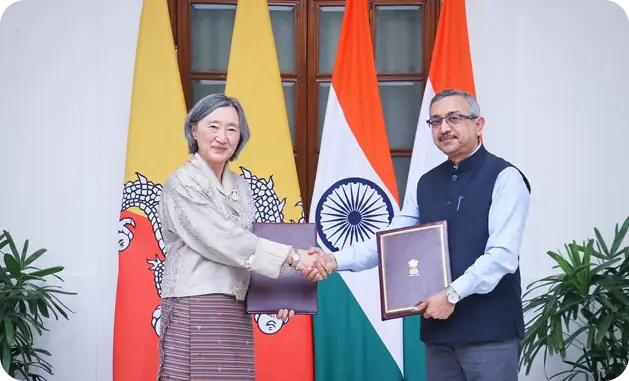
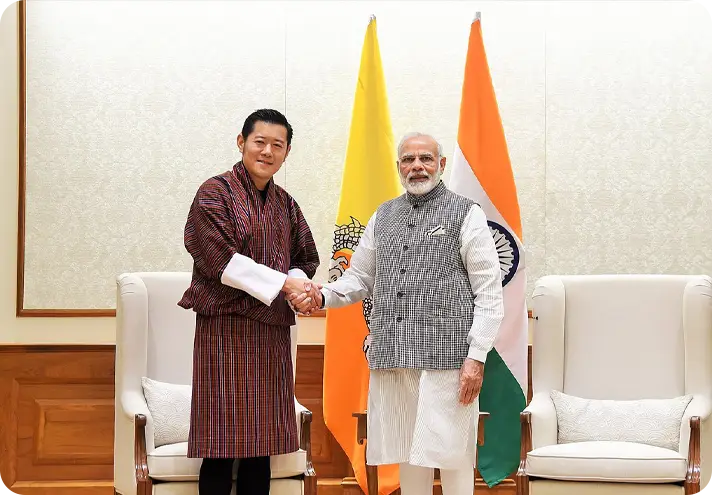
Bhutan maintains a strong and trusted partnership with India, grounded in mutual respect, shared security interests, and economic cooperation. Hydropower projects, trade agreements, and infrastructure development continue strengthening bilateral relations and regional stability.
STRATEGIC APPROACH TO OTHER POWERS
Bhutan adopts a cautious and balanced strategy when engaging global powers, prioritizing sovereignty, peace, and long-term stability. Diplomatic decisions are carefully evaluated to ensure alignment with national interests and Gross National Happiness principles.
SELECTIVE AND EXPANDING DIPLOMATIC TIES
Bhutan maintains selective diplomatic relations based on mutual trust, strategic value, and shared development goals. While carefully expanding global partnerships, the nation safeguards independent decision-making and prioritizes sustainable economic and cultural cooperation.
INTERNATIONAL ORGANIZATION MEMBERSHIP
Bhutan actively participates in international organizations to promote sustainable development, environmental protection, and global peace. Membership in regional and global bodies strengthens diplomatic engagement while aligning international commitments with national priorities.
FOCUS ON DEVELOPMENT AND SOVEREIGNTY
Bhutan’s foreign policy emphasizes balanced development while firmly protecting national sovereignty and cultural identity. External partnerships are structured to support economic growth, environmental conservation, and political stability without compromising independence.
BALANCING NATIONAL IDENTITY AND GLOBAL PARTICIPATION
Bhutan balances global participation with preservation of its cultural heritage and traditions. By engaging internationally while protecting national identity, the country demonstrates how modernization and cultural continuity can coexist harmoniously.
BHUTAN IN THE UNITED NATIONS
Bhutan joined the United Nations in 1971, viewing it as a crucial forum for a small nation to engage in international affairs and access development assistance. As a member, Bhutan is committed to peace and security, has participated in UN peacekeeping operations, and aligns its development philosophy of Gross National Happiness with the UN’s goals and the Sustainable Development Goals. While Bhutan maintains strong ties with the UN and its specialized agencies, it has a history of limited formal diplomatic relations with some other member states, including the permanent members of the UN Security Council.
SOVEREIGN EQUALITY:
Bhutan values its UN membership for providing a platform for a small nation to have its voice heard on global issues.
DEVELOPMENT:
The UN and its agencies have been a vital source of technical and financial assistance for Bhutan's socio-economic development efforts. Bhutan was also designated as a least developed country in 1971 but officially graduated from this category in 2023.
GROSS NATIONAL HAPPINESS (GNH):
Bhutan's development philosophy of GNH, which prioritizes the well-being of its people, aligns with the UN's 2015 Development Agenda and the Sustainable Development Goals.
PEACEKEEPING:
Bhutan joined UN peacekeeping operations in 2014, deploying its first contingent to the UN mission in the Central African Republic.
FOREIGN RELATIONS:
Bhutan's membership in the UN is central to its multilateral foreign policy, which has historically been more guarded due to a policy of limiting foreign influence.
SECURITY COUNCIL REFORM:
Bhutan supports the reform of the UN Security Council to be more inclusive, advocating for permanent seats for countries like India and Japan.
BILATERAL RELATIONS
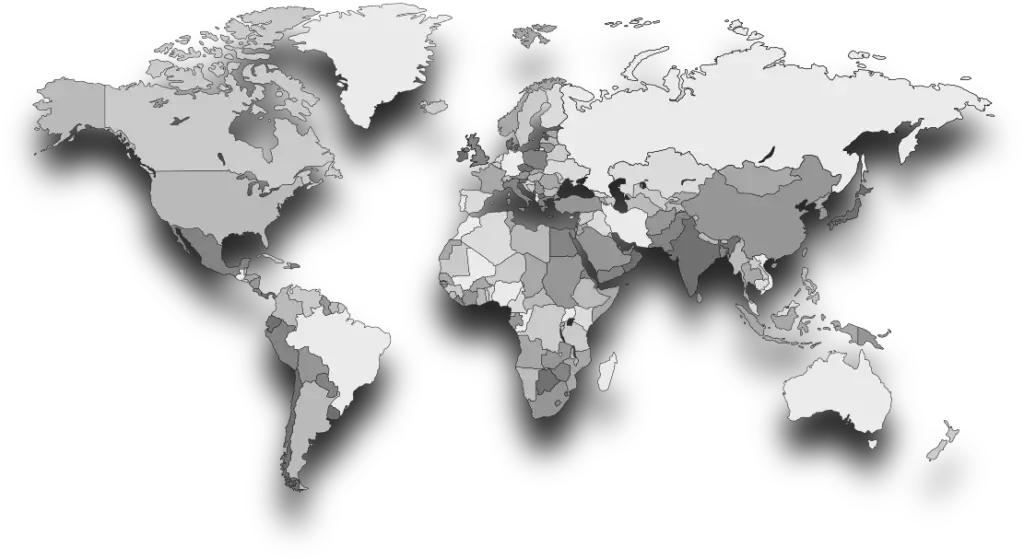
Bhutan has diplomatic relations with 58 of the other 192 member states of the United Nations and the European Union. [1] This limited number, and the absence of formal relations with any of the permanent members of the United Nations Security Council, is part of a deliberate isolationist policy of limiting foreign influence in the state. [2] This stance has been safeguarded by close relations with India, of which Bhutan has previously been considered a protected state
- 1 India
- 14 January 1968
- 2 Bangladesh
- 12 May 1973
- 3 Kuwait
- 23 May 1983
- 4 Nepal
- 3 June 1983
- 5 Maldives
- 20 July 1984
- 6 Netherlands
- 10 June 1985
- 7 Denmark
- 13 August 1985
- 8 Sweden
- 27 August 1985
- 9 Switzerland
- 16 September 1985
- 10 Norway
- 5 November 1985
- 11 Japan
- 28 March 1986
- 12 Finland
- 1 May 1986
- 13 Sri Lanka
- 13 May 1987
- 14 South Korea
- 24 September 1987
- 15 Pakistan
- 15 December 1988
- 16 Austria
- 8 May 1989
- 17 Thailand
- 14 November 1989
- 18 Bahrain
- 6 January 1992
- 19 Australia
- 14 September 2002
- 20 Singapore
- 20 September 2002
- 21 Canada
- 25 June 2003
- 22 Belgium
- 21 January 2009
- 23 Brazil
- 21 September 2009
- 24 Afghanistan
- 20 April 2010
- 25 Spain
- 11 February 2011
- 26 Cuba
- 26 September 2011
- 27 Fiji
- 18 November 2011
- 28 Morocco
- 21 November 2011
- 29 Luxembourg
- 1 December 2011
- 30 Czech Republic
- 2 December 2011
- 31 Serbia
- 9 December 2011
- 32 Indonesia
- 15 December 2011
- 33 Mongolia
- 18 January 2012
- 34 Vietnam
- 19 January 2012
- 35 Myanmar
- 1 February 2012
- 36 Argentina
- 14 March 2012
- 37 Costa Rica
- 21 March 2012
- 38 Andorra
- 23 March 2012
- 39 Mauritius
- 2 July 2012
- 40 Eswatini
- 21 August 2012
- 41 Slovenia
- 13 September 2012
- 42 United Arab Emirates
- 13 September 2012
- 43 Slovakia
- 26 September 2012
- 44 Turkey
- 26 September 2012
- 45 Armenia
- 26 September 2012
- 46 Egypt
- 14 November 2012
- 47 Kazakhstan
- 20 November 2012
- 48 Poland
- 29 November 2012
- 49 Colombia
- 21 December 2012
- 50 Tajikistan
- 24 January 2013
- 51 Azerbaijan
- 7 February 2013
- 52 Oman
- 15 March 2013
- 53 Germany
- 25 November 2020
- 54 Israel
- 12 December 2020
- 55 Saudi Arabia
- 18 September 2024
- 56 Lesotho
- 29 October 2024
- 57 Philippines
- 6 October 2025
- 58 Qatar
- 16 October 2025
GLOBAL PARTNERSHIPS
Global partnerships play a crucial role in strengthening diplomatic, economic, and cultural connections across regions and continents. Through strategic cooperation with nations and international organizations, the country promotes sustainable development, environmental responsibility, and long-term regional stability. These collaborations encourage innovation, technology exchange, trade growth, and shared learning opportunities that benefit both partners. By participating actively in global forums and multilateral initiatives, the nation contributes to peacebuilding, climate action, and humanitarian efforts. Such partnerships are guided by mutual respect, sovereignty, and common values, ensuring balanced progress while preserving national identity, cultural heritage, and independent decision-making in an increasingly interconnected world.
INTERNATIONAL RECOGNITION & AWARDS
Bhutan’s international recognition includes its role as a member of organizations like SAARC and the Climate Vulnerable Forum, its high rankings in economic freedom and the Human Development Index (HDI), and a recent award for its tourism film. Recent awards include the “Outstanding Destination Excellence Award” from National Geographic Traveler, a South Asian Travel Awards (SATA) recognition, and the International Ranger Award given to a Bhutanese forester. Additionally, the nation has received accolades for its sustainable development policies, and its leadership has been recognized internationally.
- OUTSTANDING DESTINATION EXCELLENCE AWARD: Received at the 18th National Geographic Traveler China Golden Awards Ceremony in December 2023.
- BEST LEADING HERITAGE DESTINATION: Awarded at the South Asian Travel Awards (SATA) 2025.
- FINALIST AT CANNES CORPORATE MEDIA & TV AWARDS: The tourism film "Bhutan Believe" was a finalist in 2025. INTERNATIONAL RANGER AWARD: Awarded to Jampel Lhendup, a forester at Royal Manas National Park, for his work in conservation.
- NATIONAL FLOWER: The Himalayan Blue Poppy, a rare flower that grows at high altitudes.
- UNDP SPECIAL AWARD: Presented to His Majesty the King of Bhutan for achievements in sustainable development, environmental leadership, and democratic transition.